
Trial By Fire
Wild Blueberries and fire may seem like an odd couple. But it was not that long ago the growers prune their fields in early spring or late fall with fire. It was a practice that started a couple of hundred years ago with the Indigenous peoples of the area and was so successful that it lasted until the cost of fuel and the effect on air quality made the transition a necessity.
Choose your preferred method for consuming this article.
Choose your preferred method for consuming this article. For audio learners we provide a podcast and for those who like to read, simply scroll down to the article. Each method, while dealing with the same topic, is unique.
Trial By Fire
Prince Edward Island is famous for a lot of things—red dirt, rolling potato fields, and sweeping coastal views. But it is also a heavyweight champion when it comes to wild blueberries. If you drive through the rural parts of the Island today, especially in the late summer, you will see vast, sprawling fields of low green bushes loaded with tiny, intensely sweet berries. In the fall, those same fields turn a blazing, vibrant crimson.
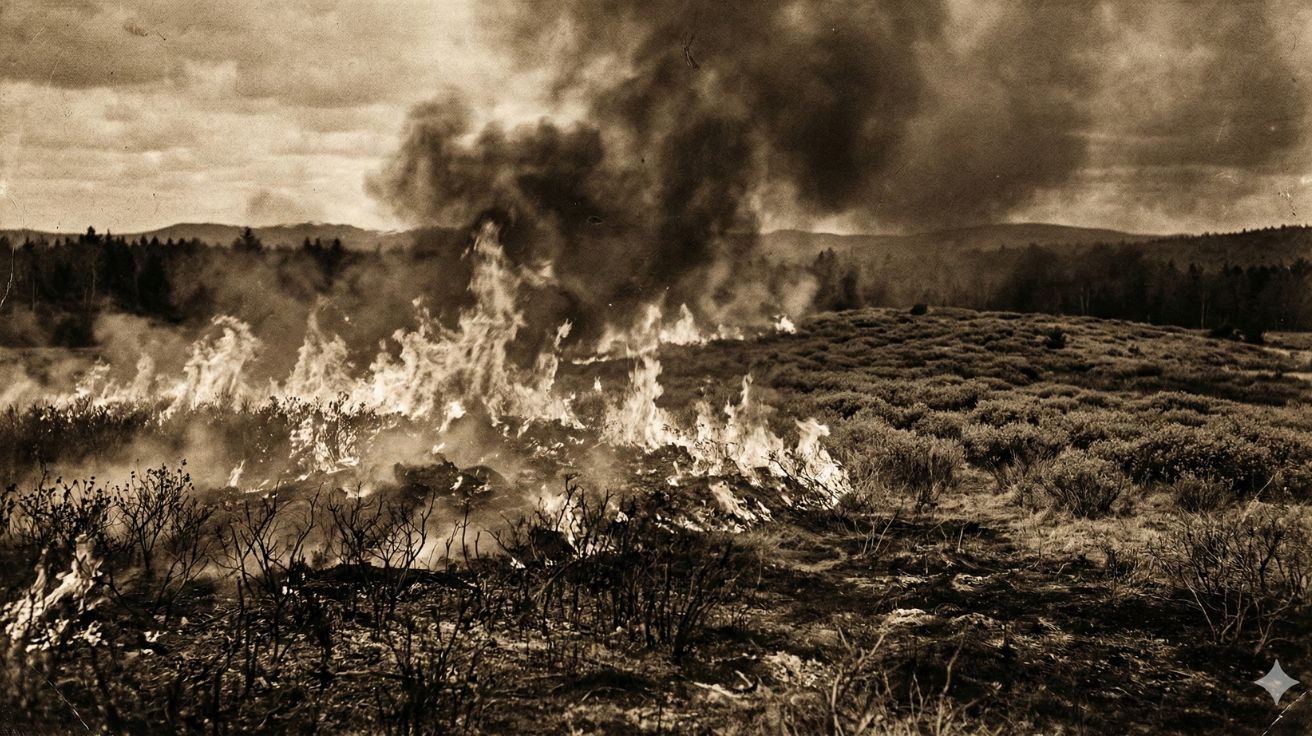
But if you were to travel back in time a few decades and take that same drive in the early spring, you might have seen those fields literally ablaze.
For generations, setting fire to wild blueberry fields was the absolute standard way to prune the plants and ensure a bumper crop. To an outsider, it sounds completely counterintuitive to light your livelihood on fire. Yet, for decades, it was the backbone of the industry. Today, the practice has almost entirely vanished, replaced by roaring tractors and heavy mowing machinery.
So, why did PEI farmers intentionally torch their fields? How did this fiery tradition begin, why didn’t the intense heat kill the plants, and why did the practice eventually flicker out? Let’s dig into the fascinating agricultural history of pruning wild blueberries with fire.
The Ancient Flame: Origins of Fire Pruning
To understand why anyone would set a blueberry field on fire, you first have to understand the origin of the plant itself. The wild blueberry—officially known as the lowbush blueberry—is a native North American plant. It has been growing in the acidic soils of Atlantic Canada since the glaciers retreated over 10,000 years ago. It is a rugged, stubborn survivor that evolved in a landscape where forest fires, sparked by summer lightning strikes, were a completely natural and common occurrence.
Long before European settlers arrived on PEI, Indigenous peoples, including the Mi’kmaq, were deeply familiar with the wild blueberry and its unique ecology. Through generations of observation, they understood the benefits of controlled burns. Indigenous communities noticed that after a natural forest fire swept through an area, the wild blueberries didn’t just survive the devastation; they completely thrived. In the years following a burn, the blueberry patches would explode with fresh, vigorous growth and produce massive yields of fruit.
Recognizing this, Indigenous peoples intentionally used fire as a brilliant land management tool. They conducted controlled burns in patches of land to clear out dense, tangled underbrush, stimulate the growth of medicinal and food plants, and make harvesting easier.
When European settlers eventually arrived in the 17th and 18th centuries and began clearing the dense Acadian forests for timber and agriculture, they took a page out of the Indigenous playbook. They noticed that wild blueberries popped up aggressively in the wake of cut-over forests and brush fires. Soon, the early settlers and farmers were managing their own wild blueberry stands using the exact same method: controlled burns.
Why Fire Didn’t Kill the Blueberries
At first glance, setting a crop on fire seems like a spectacular way to go bankrupt. If you set fire to an apple orchard, a cornfield, or a potato crop, you are not going to have much left to harvest. But wild blueberries are built differently. They are heavily fire-adapted.
The secret to their survival lies entirely beneath the soil. What we see above ground—the short, leafy stems and the berries—only makes up about 30% of the wild blueberry plant’s total biomass. The other 70% of the plant is an extensive, tangled underground network of thick stems called rhizomes.
These rhizomes act like massive underground energy reserves. When a fire sweeps across a wild blueberry barren, it burns hot and fast, scorching the above-ground stems to ash. However, the heat rarely penetrates deep enough into the cool, damp earth to damage the rhizomes.
Instead of dying, the plant takes the fire as a wake-up call. The sudden destruction of the old, woody above-ground stems triggers the rhizomes to push up brand new, highly vigorous vegetative stems.
In commercial farming, wild blueberries are managed on a strict two-year cycle. In the first year (the “sprout year”), the plant grows new stems and develops flower buds. In the second year (the “crop year”), it flowers and produces the berries. If you do not prune wild blueberries, the stems get old, branch out too much, and become woody. They start shading each other out, and berry production drops dramatically. Fire was the ultimate, natural reset button.
More Than Just a Haircut: The Hidden Benefits of the Burn
For most of the 20th century, burning was the undisputed champion of blueberry pruning, and it was not just because it stimulated the underground rhizomes. Fire provided a massive suite of side benefits that made it the perfect agricultural tool for PEI farmers.
Nature’s Pesticide:
The wild blueberry has its share of natural enemies, primarily the blueberry maggot fly and various damaging fungal diseases like Monilinia blight (often called mummy berry). By scorching the field, farmers completely sanitized the top layer of soil and plant debris. Pests that were overwintering in the dead leaves were incinerated, and harmful fungal spores were effectively wiped out by the heat.
Superior Weed Control:
Because the blueberry rhizomes are heavily protected underground, they easily survived the flames. But many competing weeds, young coniferous trees, and invasive shrubs had their shallow root systems or seeds completely destroyed by the fire. This allowed the blueberries to spread across the field without fighting for sunlight and water.
Natural Fertilizer:
Burning acted as an instant, natural fertilizer. The ash left behind from the burned stems, weeds, and fallen leaves returned valuable nutrients—like phosphorus and potassium—directly to the soil. It created a closed-loop system that kept the blueberry barrens healthy and highly productive without the need for heavy artificial chemical inputs.
The Evolution of the Burn
In the early days, farmers would rely on simple “free burns.” They would wait for the early spring when the ground was still frozen or very wet, but the dead vegetation on top was dry, and simply light the natural grasses and weeds on fire, letting the wind carry it across the field. But this was unpredictable. If the field didn’t burn hot enough, the pruning was patchy and weak.
To get a more consistent, “hard burn,” farmers in the mid-1900s started spreading loose straw or hay across the fields in the late fall. Come spring, they would ignite the straw to ensure the entire crop was evenly scorched. This was incredibly labor-intensive. Imagine manually hauling and spreading hundreds of bales of straw across dozens of acres of rough terrain.
By the 1970s and 1980s, industrial technology took over. Farmers stopped hauling hay and instead built massive, tractor-pulled burners. These heavy rigs dragged long metal booms outfitted with specialized nozzles. The nozzles blasted flaming diesel oil or propane directly downward onto the plants.
It looked like something out of an action movie, but it allowed for a highly controlled, incredibly effective burn. The tractor could drive at a steady pace, ensuring every single blueberry plant was pruned uniformly.
The Extinguished Flame: Why Burning Was Phased Out
If burning was so incredibly effective for the plants, disease control, and weed management, why don’t we see propane flamethrowers rolling across PEI’s blueberry fields today? The answer comes down to three main factors: simple economics, evolving technology, and environmental awareness.
Starting in the late 1980s and accelerating rapidly through the 1990s and 2000s, the cost of fossil fuels skyrocketed. Buying thousands of gallons of diesel oil or propane to torch hundreds of acres became financially crippling for Island growers. Profit margins in farming are notoriously tight, and burning literal fuel to burn a field was no longer sustainable.
Enter the flail mower.
Agricultural engineers developed specialized, heavy-duty tractor mowers equipped with rotating drums and heavy metal knives. These flail mowers could chop the tough blueberry stems down to within an inch of the ground, effectively shredding them.
Mowing proved to be drastically cheaper and much faster than thermal pruning. It achieved the primary biological goal—removing the old wood to stimulate the rhizomes to grow new shoots—at a fraction of the cost of buying diesel fuel. Plus, instead of leaving bare, scorched earth, the mower left behind a layer of shredded plant mulch. This mulch helped the sandy soils of PEI retain moisture during dry summer months.
Furthermore, there were growing environmental and safety concerns. Burning large tracts of land always carried the inherent risk of the fire jumping the firebreaks and spreading into nearby forests or neighboring properties. As environmental regulations tightened around air quality, smoke complaints, and carbon emissions, large-scale agricultural burning became harder to justify to the public and to regulators.
Where we are today.
Today, the vast majority of commercial wild blueberry fields on Prince Edward Island are pruned with flail mowers. The transition was not entirely without its drawbacks. By losing the fire, growers lost that incredible natural pest and weed control.
Yet, the legacy of the burn remains woven into the fabric of the industry. The wild blueberry harvests on Prince Edward Island were literally forged in fire. Those ancient flames, first recognized by Indigenous peoples and later harnessed by generations of Island farmers, shaped the resilient, sprawling blueberry barrens that feed the world today. The tractors might be quieter now, and the spring air a lot less smoky, but the deeply rooted plants beneath the PEI soil are still doing exactly what they have done for thousands of years.
Explore Our Categories
History
Health
Recipes
Interviews
Join Our Newsletter
We Hear You!
You know that moment. The one where you’re just about to scroll pass the dreaded, “Sign up for our newsletter!” graphic and you think, “Ugh, Mailing Lists?” We get it. We really do. But hear us out!
Did you know that thanks to the mysterious ways of Facebook’s algorithms, a whopping 85% of our amazing followers don’t actually see our posts? It’s true! All those delicious recipes, exciting contests, and fun updates? Most of them are just floating around in the digital ether, unseen.
That’s where our weekly newsletter swoops in like a superhero (but with less spandex, probably). It’s a handy digest of all our posts from the week, delivered straight to your inbox. No more missed recipes, no more forgotten contests, and no more wondering what we’ve been up to. Think of it as your VIP pass to all things awesome, ensuring you never miss a beat.